Buckling-restrained brace
Axial yielding of a restrained steel core dissipates seismic energy.
A steel core carries axial force while the surrounding restraint limits buckling. The core yields under repeated tension and compression, allowing the brace to dissipate energy.
Configuration & selection
Steel core and external restraint
Axial yield force and connection requirements
For selection, send the design loads, movement requirements and connection drawings. Confirm the model, dimensions and interfaces against your project drawings.
Applications
Seismic bracing systems that require stable axial energy dissipation in both tension and compression.
Key features
- A steel core carries the axial load and yields under cyclic action.
- An outer restraining assembly limits compression buckling of the core.
- Unbonded interfaces allow the core to deform within its restraint.
Technical specifications
Select yield force, axial stiffness, deformation capacity, brace length and end connections. The catalog lists common yield-force examples of 350–10,000 kN; the final brace specification follows the project analysis.
Detailed technical information
Buckling-restrained braces
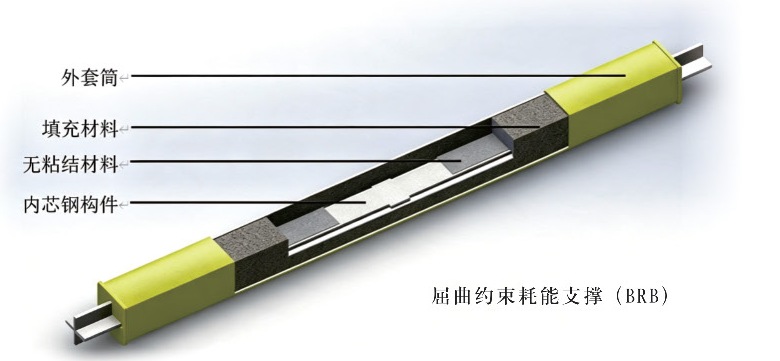
A buckling-restrained brace (BRB) has a steel core, an external restraining component such as a steel tube/concrete, and unbonding material. The brace length includes restrained yielding and non-yielding portions, an unrestrained non-yielding portion, unbonded expandable material and the buckling-restraint mechanism.
The external tube and concrete or mortar restrain core bending and prevent compression buckling. The steel core carries the axial force and dissipates energy by yielding under repeated axial tension and compression. Compared with conventional bracing, the buckling-restrained brace provides fuller hysteresis loops.
| Item | Value / description |
|---|---|
| Functions | Load resistance, energy dissipation and adjustable stiffness |
| Stated service life | More than 50 years |
| Common yield load | 350–10,000 kN |
Drawing labels: external casing, filling material, unbonding material and internal steel core.